Showing posts with label how to. Show all posts

Thursday, October 6, 2011

"An Egg Today is Better Than a Hen Tomorrow": Part V The Feed


A happy, healthy chicken will lay the best eggs.  And think of it this way:  whatever you feed your chickens, you will eventually also eat in their eggs, so it's best to feed them the best foods possible.  Chickens are also natural foragers/peckers and will destroy any vegetable and flower garden around (as well as kill off both pest and beneficial insects), it is best to keep them at least somewhat contained so they don't destroy your entire yard/garden/neighbor's yards.

So getting back to the topic:  what is best to feed chickens?  The real question is, how much work/money are you willing to put in?  Here are some options:
  • The best form of chicken food is probably going to be organic.  You can either buy the organic pre-made stuff online or from specialty stores, but that will definitely cost you a pretty penny.  Some brands you can look into that are 100% certified organic are Fertrell's, Homestead Organics, and Nature's Best Organic Feed.
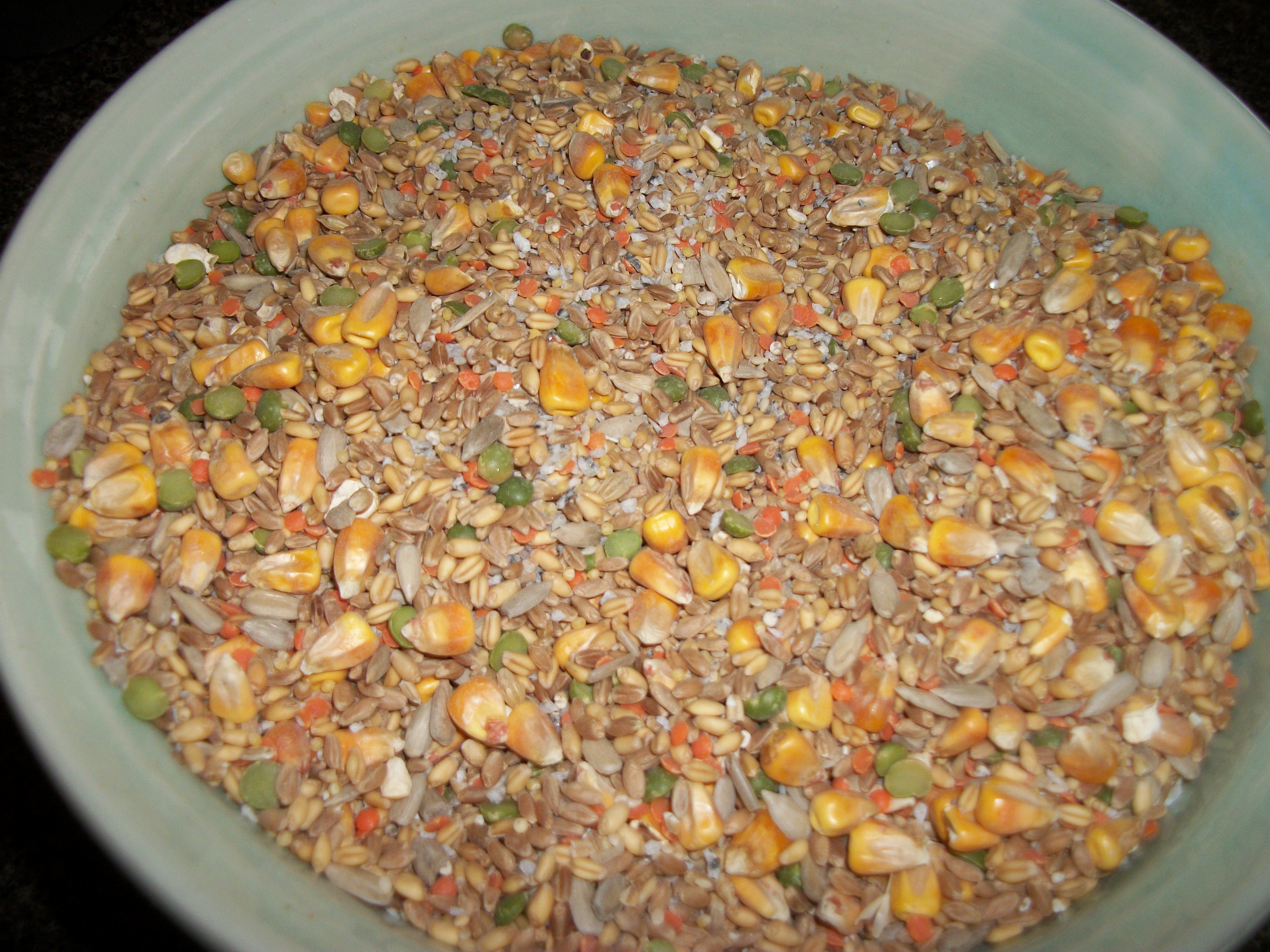
  • If you want to just make your own chicken feed (which is recommended, since then you have it all in bulk, save money, and know how fresh it is), there are TONS of resources both online and in your local library.  Here is one recipe taken from Greener Pastures Farm:

    • ***  It's not necessary to follow this recipe exactly...  just make sure your birds are getting enough protein, which is predominant in the hard red wheat and the legumes.  Free-range birds usually find plenty of protein from bugs, etc.

      2 parts whole corn (in winter this is increased to 3 or 4 parts)
      3 parts soft white wheat
      3 parts hard red winter wheat
      1 part hulled barley
      1 part oat groats
      1 part sunflower seeds (in winter this is increased to 2 parts)
      1 part millet
      1 part kamut
      1 part amaranth seeds
      1 part split peas
      1 part lentils
      1 part quinoa
      1 part sesame seeds
      1/2 part flax seeds
      1/2 part kelp granules
      free choice of granite grit
      free choice of oyster shell

      I store the above items in 6 bins; the corn in one, both types of wheat are mixed in the 2nd bin, barley in the 3rd, oat groats in the 4th, sunflower seeds in the 5th, and the remaining seeds and grains are mixed into the 6th bin.  I leave the granite and oyster shell in the bags they come in.  I then scoop out what I need into a 5 gallon bucket, and pour back and forth from one bucket to another until mixed well.
      • Ronda Jemtegaard - Greener Pastures Chickens, http://www.greenerpasturesfarm.com

Tuesday, October 4, 2011

"An Egg Today is Better Than a Hen Tomorrow": Part IV The Coop

So you've figured out that you can have chickens.  The neighbors say "ok", you found the breed you want...now where to put them.  Well, this all depends: obviously if you live in the country, you will have a lot more options due to more space available; so for the sake of this blog and people like myself who will most likely live in more urban environments, I have found some ideas for the urban chicken coop.

Backyardchickens.com has some wondeful coop ideas for small, medium, and large coops.

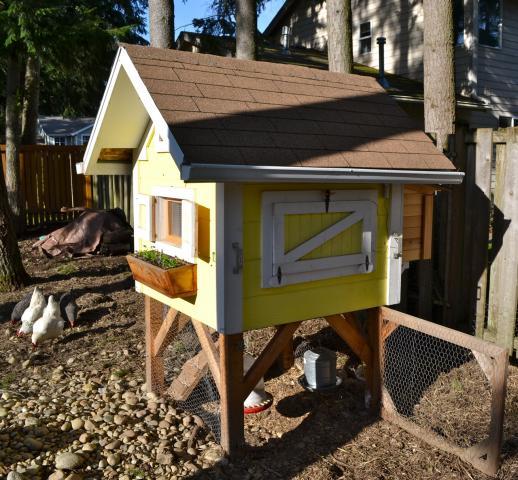
- This lovely yellow coop includes the plans, dimensions, and a step-by-step photo arrangement of how to make this exactly. 

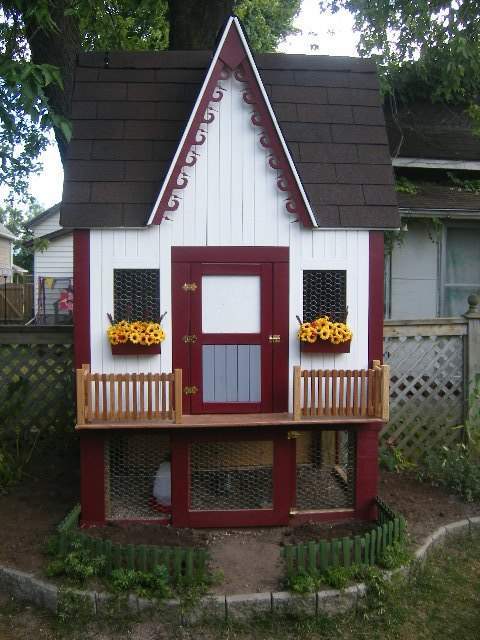
- This amazingly charming and detailed coop even has a built in little pen for the chickens to scratch around in. 

- If you want something a bit more utilitarian without the frills (but still very nice to look at), then this one might be more to your taste.

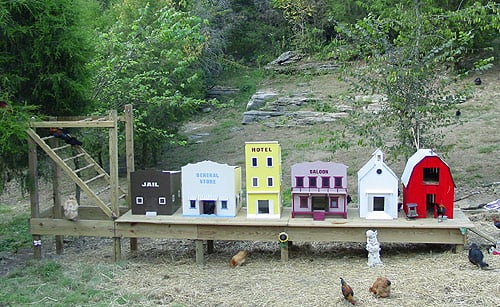
 Unfortunately, I do not know how this one was made, but it's pretty amazing.

Take a look around their site, seriously.  There are tons of amazing chicken coop ideas for all types of yards and budgets. 

Tuesday, September 20, 2011

"An Egg Today is Better Than a Hen Tomorrow": Breeds o' Chickens Part III

Just how many chicken breeds are there?  Wikipedia says "hundreds", Yahoo Answers says the same "hundreds" (since it was just copy-pasted from Wikipedia), Poultrypages.com says over 75....to put it simply, there are a lot of different types of chickens out there.  So which ones are the best for what I/people who may want an urban hen house of just a few want?

Some factors to consider:  good egg layer, friendly, not aggressive - think pet that lays eggs.  Here are some of the more popular breeds:

1. Rhode Island Red: 
- Hardy against cold weather
- A good egg layer ( average 200 per year, 5-7 per week) 
- Good with kids, but can get a bit aggressive if provoked/annoyed/poked/harassed. 
- Can be affectionate, especially with familiar people. 
- If free range/run, eggs can be too big to fit into a carton
- Egg color = brown


2. Barred Plymouth Rock ("Barred Rock"):
- Hardy against cold
- Decent egg layers (4 per week)
- Calm around familiar people
- Will run from predators
- "Smart and plucky" (sounds very chicken-ish)
- Good brooders (meaning they will incubate eggs)
- Egg color = brownish pink


3. Easter Eggers (sorta Ameraucanas, but not):
- Not a specific breed
- Egg colors = blue to green to olive to aqua and sometimes even pinkish
- Very friendly, especially with kids
- Hardy against the cold
- Decent egg layer (4 per week)
- Known to have a "fun" personality


4. Sussex:
- Come in a variety of colors (Brown, Buff, Light, Red, Speckled, Silver, White and Coronation
- Great against cold weather
- Forage well and are economical eaters
- Friendly and easy to handle
- Can't really fly away, easy to fence
- Curious (will follow you around)
- Decent egg layers (4 per week)
- Egg color = brown


For more information on these breeds and others, visit My Pet Chicken

Tuesday, September 13, 2011

"An Egg Today is Better Than a Hen Tomorrow". Are You Allowed to Have an Urban Hen House? Part II

Perhaps the first thing you should look into is the most obvious:  are you legally allowed to have a hen house where you live?  Of course, countryside/more rural residences are going to be a lot more lenient than their urban counterparts - so it's always best to just check first to see what is and is not permitted, and what steps are necessary to have one if you are allowed.  

For example: Minneapolis, MN (taken from Minneapolis Animal Care & Control - MACC)

- Are you allowed to have an urban hen house?  Yes, but you need a "small animal permit"
- What do you need to do?
1. Define the number and type of each bird to be kept on the property.
2. Obtain written consent from 80% of your neighbors within 100 feet of your property.  A copy of the consent form and the addresses needing permission can be generated by the MACC.
3. Allow the MACC to inspect the area where you wish to keep the birds for zoning and living requirements.
4. All animals must be vaccinated and licensed
- Is there an application fee?  Yes, $50
- Is there a renewal fee?  Yes, $40 = one year, $150 = five years

Unfortunately Toronto, you are not allowed to have urban chickens, as they are one of the "prohibited animals" - i.e. Galliformes.  (Schedule A to Ch. 349 - Prohibited Animals) 
However, there has been talk of changing this law as of recently, so hopefully this will be amended...after all, pigeons and rabbits are ok.  Weird.

If you are in the US and are interested in keeping back yard chickens, there's a great website that can help lead you in the right direction: http://www.backyardchickens.com/laws/search.php

Good luck!

Sunday, September 11, 2011

"An Egg Today is Better Than a Hen Tomorrow": an Introduction to the Backyard Hen House

Farm fresh eggs - that golden orange yolk, that hormone-free goodness.  We all would love to have them, but unless you have a very large wallet or live on or near a farm, you're a bit out of luck.  Perhaps this reason (and the rising popularity of a self-sustained living) is why more and more people are building backyard hen houses?  If I had the space for it, I would do it in a heartbeat.  That is why I have decided to create a series of posts about the backyard hen house - for those that can do it, but do not know how (and for myself in the future). 

For those of you who do not know/have never noticed the difference, please take a gander at this photo and article from Spoonful New York's blog:

Left = farm fresh.  Right = supermarket

Look forward to more in-depth posts about how to start your very own backyard hen house in the near future. 

Wednesday, March 30, 2011

egg basics 101

“I have had, in my time, memorable meals of scrambled eggs with fresh truffles, scrambled eggs with caviar and other glamorous things, but to me, there are few things as magnificent as scrambled eggs, pure and simple, perfectly cooked and perfectly seasoned.”  - James Beard


There is something to be said about a perfectly cooked, ungarnished/untarnished egg.  The question is:  how do you achieve such an egg?  Well, if you need help cooking an egg, this link is for you. 

From blogchef.net, this post covers eggs done sunny side up, over easy, hard boiled, soft boiled, and poached, all with excellent and delectable looking photos.  

Enjoy!